

By Jeff Popple
With the departure of American Airlines’ Senior Vice President of Network and Schedule Planning, I wanted to see how the schedule changed during his tenure. I compared a week of flying in April 2023 with a week in April 2026. The result is a bigger airline, but not one that has closed the gap with Delta and United.
A bigger airline, built on smaller airplanes
American took roughly 90 mainline deliveries over the period, with almost no retirements, so growth was no surprise. The regional fleet grew too. Weekly departures rose about 19% and seats about 14%. Average gauge fell from 129 to 123 seats because the growth came from smaller aircraft. Eagle’s share of departures went from 42% to 48%.
More hub, less everything else
The surprise is how little the network’s shape changed. About 99% of departures now touch a hub, and point-to-point flying roughly halved, from 870 to 438 weekly departures.
Mainline international flying was basically flat. Europe grew 13% in seats, while Mexico, Canada and South America fell and Asia was flat.
Retreats and challenges
- Austin: capacity fell 45%. American’s only explanation has been that it was part of a routine network review.
- LaGuardia and Reagan National: mainline capacity fell 11% and 12%. Eagle more than made up for it, so the airports grew 15% and 5% overall. This is a retreat from mainline competition, not from the markets.
- JFK: down 8%, mostly Eagle.
- San Francisco and Houston: growth of 44% and 49% in departures looks like a challenge to United, although all of the added capacity feeds American’s own hubs.
- Seattle: departures grew 37%, a show of commitment to Alaska. American added Seattle–Anchorage, one of only two new mainline US points, but dropped Seattle–London and never launched the long-announced Seattle–Bengaluru.
Widebodies: renewed, then stalled
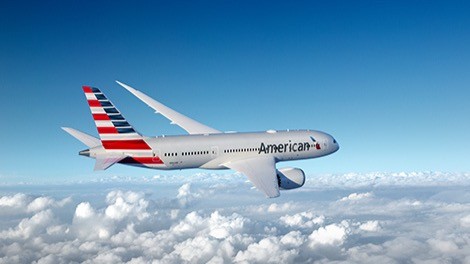
American retired 15 A330s during the pandemic, and 787-8 and 787-9 deliveries had largely replaced them by 2025. The order book, though, is thin: six 787-9s in 2027, three in 2028 and ten in 2029 or later, all 787s. American says it is shopping for more widebodies, but the 777-200 fleet is aging, and nothing is ordered.
The financial gap
American has trailed United and Delta for three years. In 2025, revenue was about $55B, against $59B at United and $64B at Delta. Operating margin was under 3%, compared with more than 9% at Delta.
What the network explains
American’s growth was almost entirely domestic narrowbody growth. Meanwhile, premium demand surged, and Delta and United were positioned to capture it. They have strong international business class, premium economy, and extra-legroom seating. On the product side, they have long had seatback video and free Wi-Fi. American added free Wi-Fi this year and has announced seatback screens and more extra-legroom seats. The timelines are slow: retrofits reportedly begin in late 2028, and the premium share of narrowbody seats rises from about 25% to 40% over several years.
What American needs to do
Premium revenue is the answer, and the pace has to pick up. American needs more high-margin international flying, which means ordering widebodies sooner. A hard product alone is not enough. The customer experience must improve too, which is why bringing in Heather Garboden as Chief Customer Officer matters. She has already made progress. According to reports of an internal memo, American will no longer involuntarily deny boarding on oversold flights, effective September 30. Believe it or not, American caused 60% of all involuntary denied boardings in the industry last year, so the change is overdue.
The next head of network planning inherits a bigger airline with a clear job: turn that growth into premium revenue.
Source: OAG airline schedule data for April 2023 and April 2026, plus company filings and press reports.
About the Author:
Jeff Popple is Director of Customer Success at Zulu Airline Systems.